

About 250 years ago, a Jewish community in Russia was suffering from a devastating epidemic. The Baal Shem Tov advised the people to write a Sefer Torah (a handwritten scroll). They wrote the Torah and the plague stopped.
Salek and Chaya Beim of Morristown, New Jersey, commissioned a sofer, a Jewish scribe, to write a Sefer Torah in the merit that their two daughters, who suffered from a severe Lupus condition, should each have a complete recovery.
 On September 11, 1992, six months after the sofer started this year-long project, the Beim's son, Danny, became the proud father of a six-pound, twelve-ounce baby boy.
As an obstetrician, Danny had seen many newborns, and his bright- faced, blonde-haired baby boy looked quite healthy. Danny's wife, Pam, needed a couple of days to rest up, but she looked forward to going home with her baby and taking an extended break from her work as a dentist.
Two days after the birth, a nurse went to get the Beim baby from the hospital nursery and noticed that he was barely breathing.
She rushed him into the intensive care unit. The doctors could not find the cause. After two days of testing, they believed that the faulty breathing stemmed from a congenital metabolic disorder which, in turn, was affecting the heart.
The doctors did an EEG on the baby. "Neurologically, it doesn't look good," the neurologist told Danny and his parents. He explained that the heart apparently was not pumping enough oxygen-rich blood, resulting in a lack of oxygen to the baby's brain.
"The EEG indicated extensive brain damage. He will never walk, talk..." the neurologist said.
Later, the neonatologist advised Danny and Pam to forget about surgery and let nature take its course. "If we fix the heart, your baby may survive, but he will be institutionalized for the rest of his life," the doctor said.
That evening Danny's sister Betty called and asked to speak to Pam. Betty worked for El Al.
"I'm going to get you a bracha," Betty said. "What does that mean?" asked Pam.
"A bracha? A blessing. There's a rabbi who works in the El Al terminal at Kennedy Airport who knows a rabbi who can pray for your baby. His name is Rabbi Schneerson, the Lubavitcher Rebbe." Betty had recently met Rabbi Yekutiel 'Kuti' Rapp, the Lubavitch emissary in Kennedy Airport.
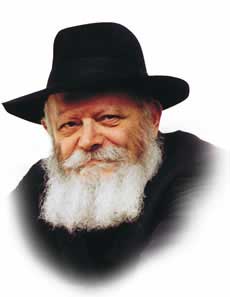
Rabbi Rapp called to report, "The Rebbe's answer is that the baby's brain will be okay; just fix his heart."
With this needed encouragement, the parents transferred their baby to Columbia-Presbyterian Hospital in Manhattan, famous for its advanced work in neonatology. The doctors there discovered that the trunks of the two main arteries leaving the baby's heart, the pulmonary and the aorta, were fused together.
The "old" and the "new" blood were mixing together, resulting in a severe lack of oxygen reaching the brain. Many risky operations had to be performed to fix this rare defect, termed persistent trunchus arteriosus, before the baby would be able to use his own heart.
In the meantime, Danny and Pam became co-sponsors in the writing of the Sefer Torah, in the merit that their son would live and be healthy.
So with the baby also in mind, the sofer continued inscribing letters in the Torah Scroll.
The baby had been in Columbia-Presbyterian for three weeks while the doctors evaluated his condition. "This is the worst case I have seen in 22 years of practice," said the neonatologist. "You have a very sick baby. I am very sorry, but you will never be able to take him home."
"I guess I just want a miracle for my son," Pam cried.
Hanging onto the Rebbe's blessing, Danny and Pam decided to transfer their baby to the Children's Hospital of Philadelphia. There, a team of doctors, headed by a Dr. Norwood, specialized in operating on babies with truncus.
The doctors at CHOP scheduled surgery on the baby's tiny heart. The delicate surgery involved dividing the arterial trunk: taking tissue from the baby's lung, and creating a wall between the divided trunks of the two arteries. This procedure had been developed only four years earlier and there were only 25 doctors in the world who were skilled at doing this type of heart surgery.
The Beim's baby was not strong--he weighed less than 10 pounds-- so the surgery was doubly risky, but the Beim's gave the go ahead with it.
The sofer dipped his quill in the black bottle of ink, day after day, month after month. Then, on July 4, 1993, under an open tent on the lawn of Congregation Ahavas Yisroel in Morristown, New Jersey, the final 250 letters of the Torah Scroll were filled in by many friends of the Beim family.
Salek Beim filled in the last letter of the Torah, and exuberant singing erupted. The Torah was rolled up and covered with a velvet mantle, and everyone danced the Torah down Sussex Avenue to the Rabbinical College of America campus.
A robust, ten-month old boy, held in the arms of his smiling father, leaned over and gave the Torah a kiss. This healthy, bright boy was Avrohom Chaim "Alex" Beim.
"What can I say? You saw my baby today," said Danny, at the dinner following the Torah dedication ceremony. "I attribute Alex's miraculous recovery to the Rebbe's blessings and guidance. The Rebbe is proof that there is a G-d in this world.